
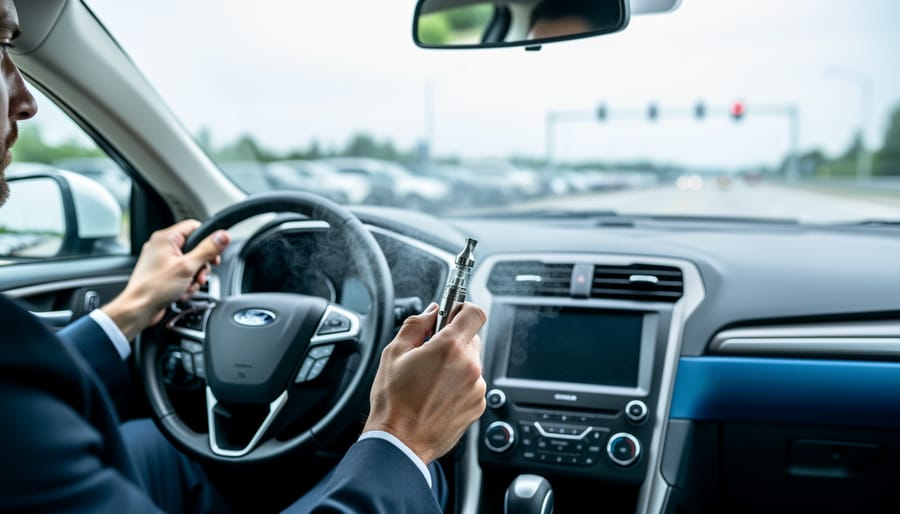
Vaping in your car is generally legal across Canada, but you can face serious consequences if a minor is present in the vehicle or if the act itself becomes a distraction. The law treats vaping differently depending on your province and the specific circumstances, which means what’s perfectly fine in one situation could land you in hot water in another.
The confusion is understandable. Canada’s regulatory framework splits authority between federal and provincial governments, creating a patchwork of rules that vary by location. At the federal level, there’s no outright ban on vaping while driving. However, provincial legislation around smoking and vaping in vehicles with minors, combined with distracted driving laws, creates real risks for vapers who aren’t paying attention to the details.
Sarah Chen, a Toronto-based vaper and frequent road-tripper, learned this the hard way. “I thought vaping was totally fine since it’s not smoking,” she explains. “Then a police officer pulled me over and explained that because my friend’s teenage daughter was in the back seat, I was breaking provincial law. I had no idea.”
The stakes get higher when you consider distracted driving regulations. Officers have discretion to determine whether your vaping behavior interferes with safe vehicle operation. Cloud-chasing with a high-powered device that obscures your vision? That’s asking for trouble, regardless of whether minors are involved.
This guide breaks down exactly where and when you can vape in your car, what restrictions apply in each province, and how to stay on the right side of the law while satisfying your nicotine needs on the road.
The Federal Position: What Canadian Law Says About Vaping in Vehicles
At the federal level, Canadian law does not prohibit vaping while operating a vehicle. Unlike tobacco cigarettes, which fall under the Tobacco and Vaping Products Act for product regulation, vaping devices occupy a distinct legal category that doesn’t include specific driving restrictions from Ottawa.
The federal government’s approach focuses on product safety and access rather than usage contexts. Vaping product regulations from Health Canada concentrate on manufacturing standards, nicotine concentration limits, packaging requirements, and youth access prevention. You won’t find federal rules dictating where or when you can use your vape device once you’ve legally purchased it.
This creates an important distinction for drivers: while federal tobacco legislation has historically addressed smoking in vehicles (particularly regarding minors), vaping entered the regulatory landscape later and under different frameworks. The federal stance essentially leaves driving-related vaping rules to provincial and territorial governments, which have taken varied approaches.
Understanding this federal-provincial split matters because it means you can’t rely on a single nationwide answer. What’s permissible in one province might carry penalties in another, even though you’re technically following federal law in both cases. The federal government sets the baseline for what vaping products can be sold and who can buy them, but your province determines the specific situations where using them behind the wheel becomes problematic.
Provincial and Territorial Restrictions You Must Follow
When Minors Are in the Vehicle
Most Canadian provinces have enacted laws specifically protecting minors from secondhand vapor exposure in vehicles. The age threshold varies by jurisdiction, some provinces protect those under 16, while others extend protection to passengers under 18 or 19. What remains consistent across these regulations is the principle: if you’re driving with someone below the specified age, you cannot vape in that vehicle, regardless of whether it’s in motion or parked.
These laws recognize that vehicle interiors concentrate vapor in enclosed spaces, creating higher exposure levels than open-air environments. Children and teenagers in cars cannot simply leave if they’re uncomfortable, making this a captive exposure situation that legislators have deemed worth preventing.
The enforcement approach tends to focus on education first, though violations can result in tickets. What constitutes a “minor” under these laws depends entirely on your province’s specific legislation. Ontario, for example, prohibits vaping in vehicles carrying anyone under 16, while other jurisdictions set different age limits based on their smoking and vaping act definitions.
Before you vape in your car, you need to verify two things: the age threshold that applies in your province or territory, and whether any passengers fall below that limit. Provincial government websites and official motor vehicle acts provide the authoritative answer, don’t rely on secondhand information or assumptions based on other provinces’ rules. The variation between jurisdictions means what’s permitted in one province may be prohibited in another, making local verification essential rather than optional.
Municipal Bylaws and Local Variations
While provincial laws set the baseline for vaping regulations in vehicles, some cities have taken matters a step further with their own bylaws. These local rules can catch drivers off guard, particularly in larger urban centers where municipal councils have enacted additional restrictions.
Urban areas sometimes implement bylaws that go beyond provincial legislation, especially concerning public health and air quality. These might include restrictions on where you can vape in municipal parking lots, near public building entrances, or in specific districts. The challenge is that these local regulations aren’t always well-publicized, and enforcement can vary significantly from one municipality to another.
Before you vape in your car within city limits, it’s worth taking a few minutes to check your municipality’s website or contact the bylaw office directly. This is especially important if you’re traveling to a different city or if you frequently drive through multiple jurisdictions. What’s perfectly legal in your home province might face additional restrictions in certain urban areas.
The practical takeaway? Don’t assume that provincial legality means universal permission across all municipalities. Local bylaws can add layers of complexity, and ignorance won’t protect you from potential consequences. When in doubt, err on the side of caution or simply wait until you’re back in familiar territory where you know the rules.
Distracted Driving: Where Vaping Can Get You in Trouble
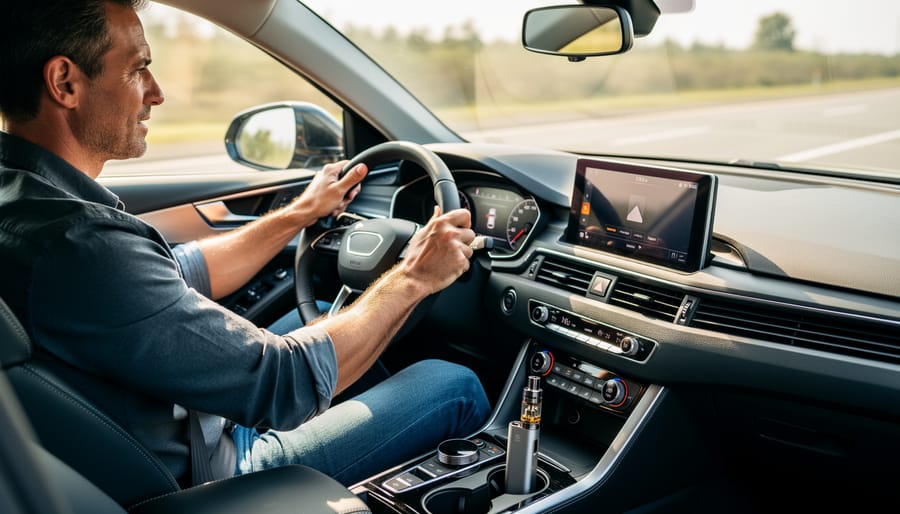
While vaping itself isn’t illegal behind the wheel, it can land you in hot water under distracted driving laws if an officer determines it’s interfering with your ability to drive safely. The key principle is simple: anything that takes your attention from the road or removes a hand from the wheel can be considered a distraction.
The riskiest scenarios involve active device manipulation while moving. Adjusting wattage settings, changing coils, or refilling a tank all require visual attention and manual dexterity that should be directed at driving. Even something as routine as clearing a flooded atomizer or wiping down a leaking tank pulls your focus away at exactly the wrong moment. If you need to fiddle with your device, pull over safely first.
Vapor production itself can become problematic. A thick cloud that temporarily obscures your windshield or mirrors creates a genuine safety hazard, and officers have discretion to cite drivers whose vapor clouds impair visibility. Cracking a window helps, but even with ventilation, producing massive plumes while navigating traffic isn’t advisable.
Officer discretion plays a significant role here. One officer might issue a warning for minor device adjustment, while another could write a citation for the same action. The consequences vary by province, with different penalty structures and demerit point systems. Some jurisdictions treat all distracted driving violations uniformly, while others have tiered approaches.
The practical takeaway is straightforward: prepare your device before you start driving, keep draws quick and moderate, ensure proper ventilation, and never attempt device maintenance or adjustments while the vehicle is in motion. If your device malfunctions or needs attention, find a safe place to stop. No vape session is worth a collision or citation.
Real-World Experiences: What Vapers Say About Driving
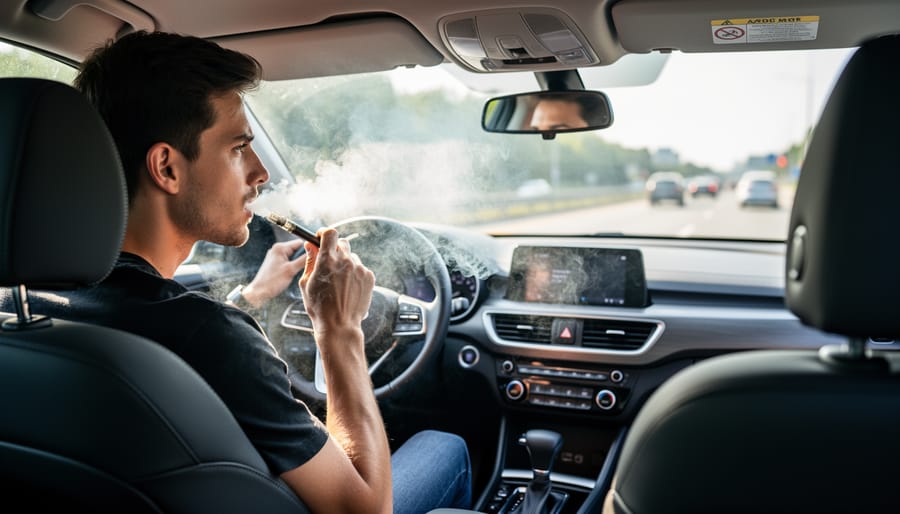
The vaping community has accumulated years of practical wisdom about vaping while driving, and their insights reveal a consistent pattern of common-sense approaches that go beyond what the law technically permits.
Many experienced vapers stress the importance of preparation. “I always make sure my device is set up before I start the car,” shares one Toronto-based vaper. “Fiddling with settings or refilling while you’re moving is just asking for trouble.” This sentiment echoes across forums and social media groups, where drivers emphasize having everything ready at stoplights or before departure.
Window management emerges as a near-universal courtesy. Even vapers who drive alone typically crack a window to prevent vapor buildup on the windshield, which can create a film that reduces visibility over time. When passengers are present, the consensus is clear: ask first, and keep airflow moving regardless of their answer.
The most frequently cited lesson learned involves knowing when not to vape. Vapers report avoiding their devices during challenging driving conditions like heavy traffic, poor weather, or unfamiliar routes. “There’s a time and place,” one Vancouver driver notes. “If I’m navigating downtown in the rain, the vape stays in the cupholder.”
Community members also emphasize awareness of how their habits appear to others. Producing massive clouds at stoplights or in parking lots draws unwanted attention and reinforces negative stereotypes about vapers. The recurring advice is simple: be discreet, be considerate, and remember that your car isn’t your living room when you’re sharing the road with others.
Rental Cars and Company Vehicles: Special Considerations
When you’re behind the wheel of a rental or company vehicle, the rules change. These aren’t legal restrictions in the traditional sense, they’re contractual obligations that can hit your wallet or your employment status.
Most major rental companies explicitly prohibit smoking and vaping in their vehicles. You’ll find this buried in the fine print of your rental agreement, often listed alongside smoking tobacco. The consequence isn’t a traffic ticket; it’s a cleaning fee that the company determines, typically charged to your credit card after you’ve returned the vehicle. Some companies treat vaping residue the same as cigarette smoke damage, while others may be more lenient, there’s no standard industry practice.
Company vehicles present a different challenge. Your employer’s policy might ban vaping entirely, restrict it to certain circumstances, or say nothing at all. Unlike rental agreements where the worst outcome is a financial charge, violating an employer’s vehicle policy can lead to disciplinary action or affect your job status.
The smart approach: read your rental agreement before you drive off the lot, and check your company’s vehicle use policy if one exists. When in doubt, ask directly rather than assume. If you must vape during a long drive in either type of vehicle, consider pulling over at rest stops instead. It’s not worth the hassle or potential costs.
Best Practices for Vaping Safely and Legally While Driving
If you’re going to vape while driving, being smart about it makes all the difference. Here’s how to do it right.
Get everything ready before you turn the key. Your device should be fully charged, filled, and set to your preferred power level while you’re still parked. If you use refillable tanks, choose the right bottle size that minimizes the need for mid-drive refills. Those who vape CBD strains for anxiety during commutes should have everything dialed in beforehand.
- Prepare your device completely before starting the engine, check battery, e-liquid level, and power settings.
- Lower your wattage to reduce vapor production and maintain visibility through your windshield.
- Crack a window slightly for ventilation, even in winter, to prevent vapor buildup.
- Take shorter, controlled draws rather than massive clouds that obscure your view.
- Keep your device in a secure cup holder or mount, never in your lap where it can roll.
- Pull over completely if you need to adjust settings, refill, or troubleshoot your device.
- Be aware of who’s in the car, skip vaping if minors are present in provinces where it’s prohibited.
Ventilation deserves special attention. Even small amounts of vapor can fog windows or reduce visibility in certain light conditions. Opening a rear window creates better airflow than cracking the driver’s window, and it keeps the breeze from blowing directly on you.
Remember that device maintenance while moving counts as distracted driving. If your tank starts leaking, your battery flashes a warning, or you need to change your CBD bottle size find a safe place to stop. The two minutes you spend parked beats the risk of a distracted driving charge or, worse, an accident.
Frequently Asked Questions
Can you vape in a parked car?
Yes, you can vape in a parked car in most Canadian jurisdictions, provided no minors are present if provincial laws prohibit it. Since the vehicle isn’t moving, distracted driving concerns don’t apply, though you should still check local bylaws and parking restrictions.
Does vaping vapor affect breathalyzer tests?
Modern breathalyzers are designed to detect alcohol in your breath, not vapor from e-liquids. While vapor won’t cause a false positive for alcohol, officers may ask you to wait a moment before testing if you’ve just exhaled a large cloud to ensure an accurate reading.
Can passengers vape in my car?
Passengers can vape in your vehicle under the same rules that apply to drivers, primarily that minors cannot be present if your province prohibits vaping with children in the car. As the driver, you’re ultimately responsible for ensuring compliance with these regulations.
How do you remove vaping residue from car interiors?
Regular cleaning prevents buildup on windows and surfaces. Use a microfiber cloth with glass cleaner for windows, wipe down dashboard and plastic surfaces with mild detergent, and vacuum upholstery regularly to keep your interior fresh and residue-free.
Beyond these common questions, many vapers wonder whether their insurance could be affected by vaping in the vehicle. Generally, vaping itself won’t impact your car insurance rates or coverage, but damage to your vehicle’s interior from neglected cleaning could reduce resale value. If you’re concerned about maintaining your car’s condition while managing anxiety through vaping, exploring options like the best CBD anxiety strains might offer a nicotine-free alternative that produces less residue.
Another frequent concern is whether rental companies or employers track vaping in their vehicles. While there’s no standardized monitoring system, rental agreements typically include clauses about smoking and vaping, and returning a vehicle with noticeable vapor residue or odor may result in cleaning charges. Company vehicles often fall under workplace policies rather than legal restrictions, so check your employee handbook for specific guidance.
Vaping while driving your car is generally legal across Canada at the federal level, but that’s only part of the story. Provincial and territorial laws add important restrictions, particularly when minors are passengers in your vehicle. These regulations exist to protect children from secondhand vapor exposure, and violating them can result in penalties that vary by jurisdiction.
Beyond statutory restrictions, distracted driving laws remain your biggest concern. If vaping interferes with your ability to operate your vehicle safely, whether through device adjustments, cloud production that obscures your vision, or any other distraction, you can face consequences under distracted driving legislation. Officers have discretion in these situations, and the threshold for what constitutes a violation isn’t always clear-cut.
The takeaway? Stay informed about your province’s specific regulations, especially regarding age thresholds for minor passengers. Check your municipality’s bylaws if you live in an urban area, as local rules sometimes add extra layers of restriction. If you’re using a rental or company vehicle, review the terms of your agreement to avoid unexpected cleaning charges or policy violations.
Most importantly, prioritize safe driving above everything else. Being a responsible member of the vaping community means respecting the law, protecting vulnerable passengers, and ensuring your habits never compromise road safety.